
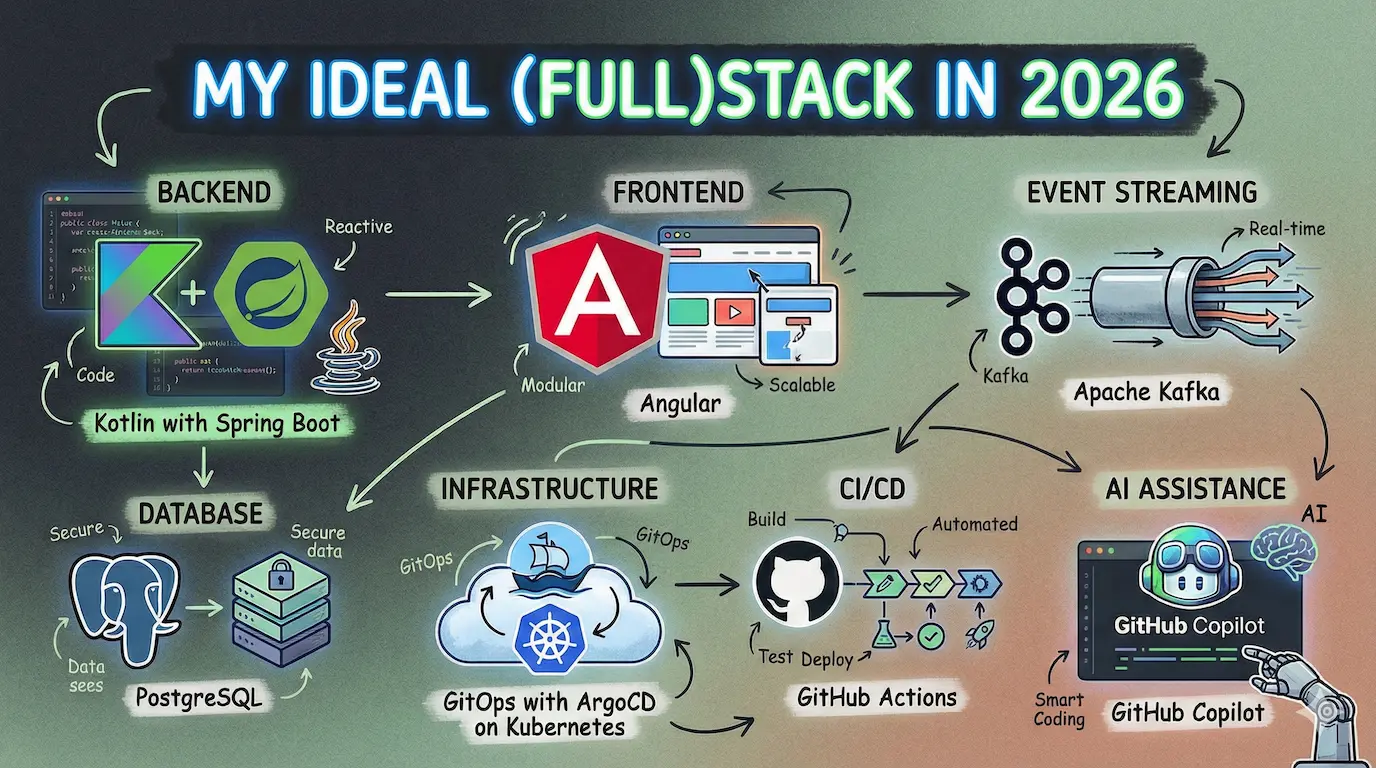
Let’s get straight to the point. Here is my ideal stack for building applications in 2026. And yes, it’s pretty full if you ask me :)
- Backend: Kotlin with Spring Boot
- Frontend: Angular
- Database: PostgreSQL
- Event streaming: Apache Kafka
- Infrastructure: GitOps with ArgoCD on Kubernetes
- CI/CD: GitHub Actions
- AI Assistance: GitHub Copilot & Claude Code
Backend
At my university I was taught mostly Java 8 and C, and got in touch a little bit with PHP, JavaScript and Python. Java stuck with me the most, especially because the compiler made me feel like a helper, pointing out mistakes before they could hit the running code.
When I started working as a junior software developer after my studies, I was put on a backend of a big Dutch webshop. Java with Spring Boot is what they used, and boy did Spring Boot magic give me a hard time. The steep learning curve as a junior wasn’t the most fun experience, but looking back, I realize just how much power the Spring Boot framework offers.
The company decided to adopt Kotlin in the backend after positive feedback from the Android developers. Again, being a junior, I didn’t understand why we would switch away from the amazing Java language. Learning Kotlin a step at a time, I realized that it is basically Java but better. The null safety features, immutability, readable syntax and extensive standard library truly made me more productive and write better code.
Even though Java is catching up to Kotlin feature wise, whenever I go back to Java I feel like going back in time. Now that Spring officially supports Kotlin, this is my pick for 2026!
What makes Kotlin & Spring great in 2026?
- The new K2 compiler is much faster
- IntelliJ support is great
- Next level Kotlin support in Spring Boot 4

Frontend
As someone coming from pure backend development, I never had a great relationship with the frontend frameworks I tried. Vue and React felt too complicated, and without real experience at a company it was hard for me to learn.
This changed when I started at a project where we had to maintain an Angular frontend. The choice for Angular was already made, and luckily, two of my senior colleagues had experience with it. Somehow, this time it clicked immediately, and the full stack developer in me was born.
I hear the React developers screaming right now, maybe one day I’ll be on your side! Until then… this is why I picked Angular
With the ng command line and out-of-the-box project setup, Angular is my pick for 2026!
What makes Angular specifically good in 2026?
- The new signals allow for more expressive state management, without RxJS
- The new control flow makes templating more performant and readable
Database
Should I say more? PostgreSQL has been great for years. It is widely used and supported, open source and has a great community.
Why use PostgreSQL in 2026?
- The vector database feature makes it great for AI-powered applications like RAG
- Support for SSO and OAuth 2.0
- Supports NoSQL with their JSONB column type (no MongoDB needed!)
Event Streaming
When building a distributed system with microservices and high workload, real-time data processing is not only a good business case, it’s vital for a scalable system. My pick for streaming platform is Apache Kafka. Although there are many things to consider when configuring a Kafka cluster, it’s so feature rich, performant and well-supported that other platforms seem pale in comparison.
For example, compared to RabbitMQ that delivers the messages and then deletes them, Kafka allows consumers to replay messages as long as they are on the topic. When new consumers are added later, older messages can be read to fill their own state.
Oh, and I suggest taking some training in both event-driven architecture and Apache Kafka, as I’ve seen many “interesting” approaches.
Is Kafka still relevant in 2026?
- Tiered storage reduces cloud costs
- Diskless topics are promising, lowering costs and increased scalability
Infrastructure
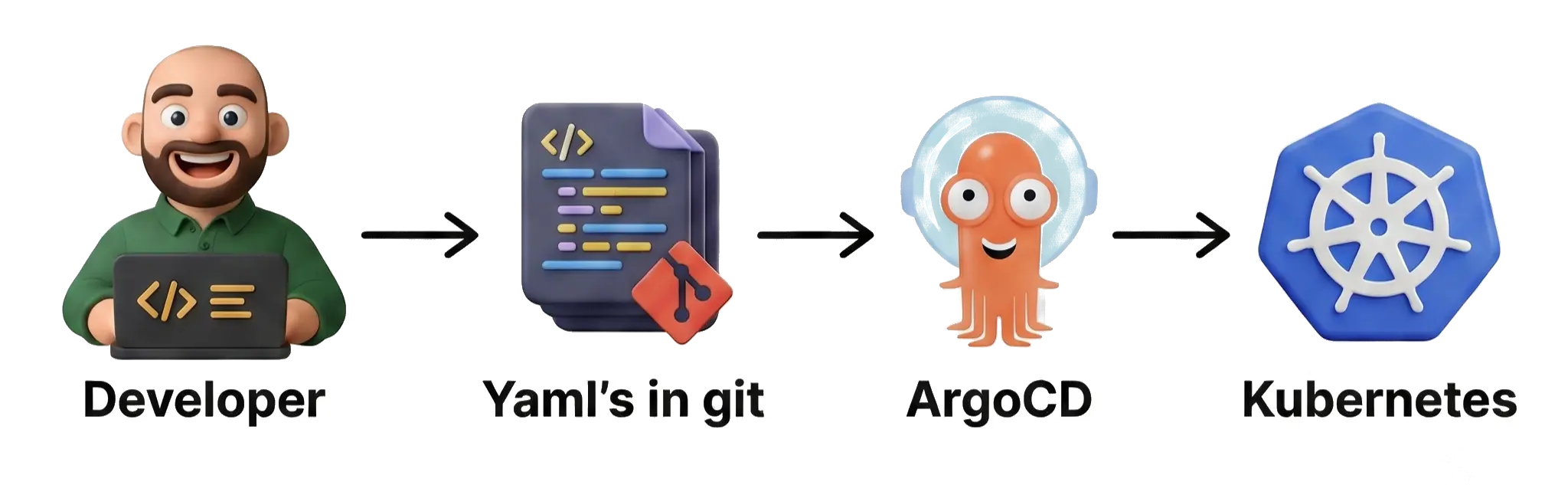
Kubernetes is the proven industry standard for hosting microservices. In combination with infrastructure as code using the GitOps approach, I had a great developer experience in the last 4 years. ArgoCD makes syncing your yaml definitions to k8s a breeze. Give teams power over their own applications!
Why GitOps in 2026?
- It empowers devops teams to self-service their own applications
- History is tracked, allowing easy rollbacks and change management
CI/CD
So far, I’ve used Jenkins, GitLab runners, Tekton and GitHub actions. From all of these, GitHub actions stood out to me as it is well-integrated in GitHub, is relatively simple and the pipelines run quite fast compared to the others.
Why GitHub Actions in 2026?
- Good support from GitHub
- Fast and reliable
- Large community with many examples
- POssible to share common workflows between teams, improving collaboration
AI Assistance
The AI tooling has evolved greatly over the last years and keeps developing, so I expect this pick will be the least
future-proof. First is my good ald friend: GitHub Copilot. It is so well integrated in my development workflow
that not having copilot feels… naked. GitHub Copilot sits as a plugin in my IDEA (IntelliJ IDEA) and helps me with the
following:
- Completes lines or functions based on the context
- Allows me to quickly ask questions about the project
- The new agent mode can implement larger tasks
- Reviews Pull Request in GitHub web
Claude Code is relatively new for me, but I am amazed with the agentic capabilities so far. Especially in large projects, Claude is a beast at agentic tasks. Searching files, executing commands, writing code, it can do it all. Combined with the Claude Skills which allows you to create sub-agents for specific and recurring tasks, it’s a powerful assistant.
One cool use case that Claude Skills is helping me with is creating a test plan for my change. It will look at the changed code and understands how the end-to-end flow will be affected. It suggests changes to the e2e test or commands to run specific tests.
Unfortunately, AI always hides rookie mistakes in its responses, making it both useful and a liability.
Why these in 2026?
- Claude Code has momentum and Anthropic is cooking with their new LLM models
- Command line is the new UX
- GitHub Copilot is high quality and well integrated
Conclusion
That’s a wrap! I am curious what your top picks are for your ideal stack and how my preferences will change over time. Which platforms, techniques and frameworks do I really have to try this year?